Optimizing Denoising Trajectories in dLLMs: A Lightweight Evolutionary Heuristic Approach
Abstract
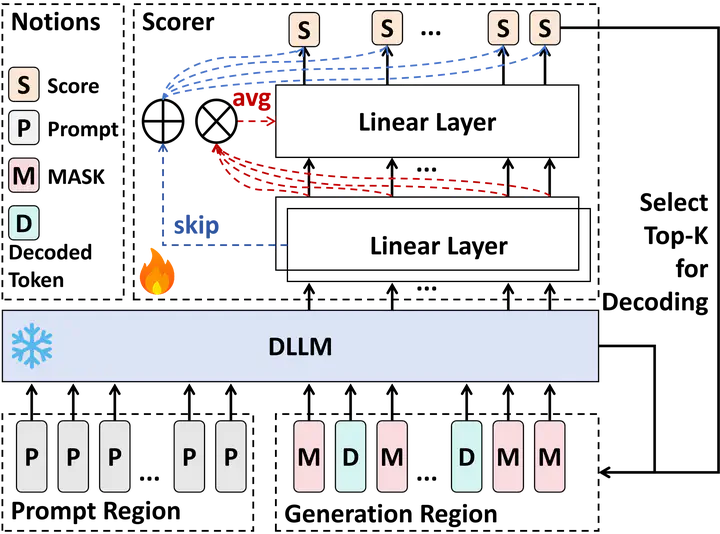
Diffusion Large Language Models (dLLMs) have recently emerged as a promising alternative to conventional Auto-Regressive (AR) Large Language Models (LLMs). By leveraging bidirectional attention and parallel decoding, dLLMs enable more efficient generation. However, they require a carefully designed denoising scheduler at inference time (absent during training) whose choice significantly impacts generation quality. While confidence-based heuristic schedulers have shown strong empirical performance, they suffer from two critical failure modes – EOS Overflow and Proximal Bias. Through in-depth analysis of the Transformer’s attention patterns, we reveal that these failures stem from certain positions assigning disproportionately high attention weights to invalid tokens (e.g., [MASK] and [EOS]), which produce misleading confidence signals. Building on this insight, empirical evidence shows that valid attention scores can provide complementary guidance to conventional confidence-based heuristics, yet no single metric consistently excels across all scenarios, implying that the optimal denoising trajectory is highly context-dependent. To address this problem, we propose a lightweight evolutionary heuristic scheduler optimized using the Covariance Matrix Adaptation Evolution Strategy (CMA-ES). Our scheduler dynamically integrates multiple heuristic features with a contextual mean-field embedding, while requiring only 393 trainable parameters. Evaluated on LLaDA and Dream across four reasoning and planning benchmarks, our method consistently outperforms strong baselines, including conventional heuristics, block auto-regressive methods, and recent State-Of-The-Art (SOTA) approaches. To the best of our knowledge, it represents the most parameter-efficient neural scheduler to date. Our code is available at https://github.com/RS2002/Evo-Denoise .